- Voltage drop
- Maximum practical run length
- Current
- Cable requirements
- Cut length
- Power supply selection
- Application compatibility
12V vs 24V LED Strip at a Glance
| Factor | 12V LED Strip | 24V LED Strip |
|---|---|---|
| Voltage drop | More noticeable over long runs | Better for longer runs |
| Current at same wattage | Higher | Lower |
| Cut intervals | Usually shorter | Usually longer |
| Long installations | Less suitable | More suitable |
| Vehicle/battery systems | Very suitable | Depends on system |
| Commercial lighting | Suitable for short runs | Usually preferred |
| Power supply | 12V constant voltage | 24V constant voltage |
The important point is that voltage itself does not determine brightness or product quality.
A properly designed 12V LED strip can achieve the same lumen output, CRI and color quality as a comparable 24V version.
The main difference is how the electrical system behaves.
Why Does 24V Usually Perform Better Over Longer Distances?
A 24V LED system does not perform better over long distances simply because the voltage number is higher. The real advantage is that, for the same power, 24V requires less current.
lower current directly means lower voltage loss.
Same conductor, half the current: the 24V system produces only half as much voltage drop across the same resistance in this simplified example.
In simple terms: lower operating current means the system loses voltage more slowly as conductor resistance increases with distance. This is why 24V is generally better suited to longer LED strip runs than 12V at the same power level.
What Is Voltage Drop?
Voltage drop occurs because every conductor has electrical resistance.
As current travels along the LED strip PCB, part of the voltage is lost across the copper traces.
If the voltage drop becomes too large, the end of the strip may receive less voltage than the beginning.
Typical symptoms include:
- Lower brightness at the far end
- Uneven light output
- Color inconsistency
- Reduced operating power
- Unstable RGB or tunable-white performance
Because a 24V system carries less current at the same power level, it generally experiences lower resistive losses than a comparable 12V system.
This is one of the main reasons 24V is widely used in professional lighting installations.
But it is important not to use voltage alone to predict maximum run length.
A high-power 24V strip with narrow PCB traces can still experience significant voltage drop.
When Is 12V the Better Choice?
12V remains very useful and, in some projects, is the better option.
Short Installations
For short shelves, cabinets, signs or display lighting, voltage drop may be very small.
In this situation, 12V can perform perfectly well.
Vehicle and Battery Systems
Many vehicles and battery-powered systems are based around 12V electrical architecture.
A 12V LED strip can therefore be easier to integrate into applications such as:
- Vehicles
- RVs
- Boats
- Portable displays
- Battery-powered lighting
Shorter Cut Intervals
Many 12V LED strips use smaller electrical groups than comparable 24V versions.
This often allows shorter cutting intervals.
For furniture, shelving and other compact installations, this can provide more flexibility when exact lengths are required.
When Should You Choose 24V?
For many new commercial and architectural projects, 24V is usually the more practical choice.
Longer Runs
Lower current makes it easier to maintain consistent brightness over longer distances.
Commercial and Architectural Lighting
Retail displays, ceiling coves, hotels and large cabinet systems often benefit from 24V system design.
Higher-Power LED Strips
As power increases, current becomes more important.
Using 24V can reduce current through the PCB, cable, connector, dimmer and controller.
More Efficient System Design
Lower current can make it easier to manage:
- PCB current loading
- Cable size
- Connector load
- Controller capacity
- Power injection
This does not mean 24V eliminates voltage drop.
It simply provides more electrical headroom for many projects.
Does 24V Mean Better LED Strip Quality?
No.
A 24V LED strip is not automatically better than a 12V LED strip.
Product quality depends on many other factors, including:
- PCB copper thickness
- PCB width
- LED chip quality
- circuit design
- thermal management
- CRI
- Color consistency
- Adhesive quality
- Soldering quality
- Manufacturing consistency
For example, a poorly designed 24V strip using narrow PCB traces and insufficient copper may still have serious voltage-drop problems.
At the same time, a well-designed 12V strip with adequate copper and appropriate power density can perform very reliably.
Professional buyers should therefore evaluate the complete LED strip design rather than focusing only on voltage.
Can You Connect a 12V LED Strip to a 24V Power Supply?
Normally, no.
The LED strip voltage should match the constant-voltage power supply.
Connecting a standard 12V strip directly to a 24V power supply can damage the LEDs and other components.
Likewise, a 24V strip connected to a 12V power source will not operate at its intended performance.
Always confirm the strip voltage before selecting the power supply.
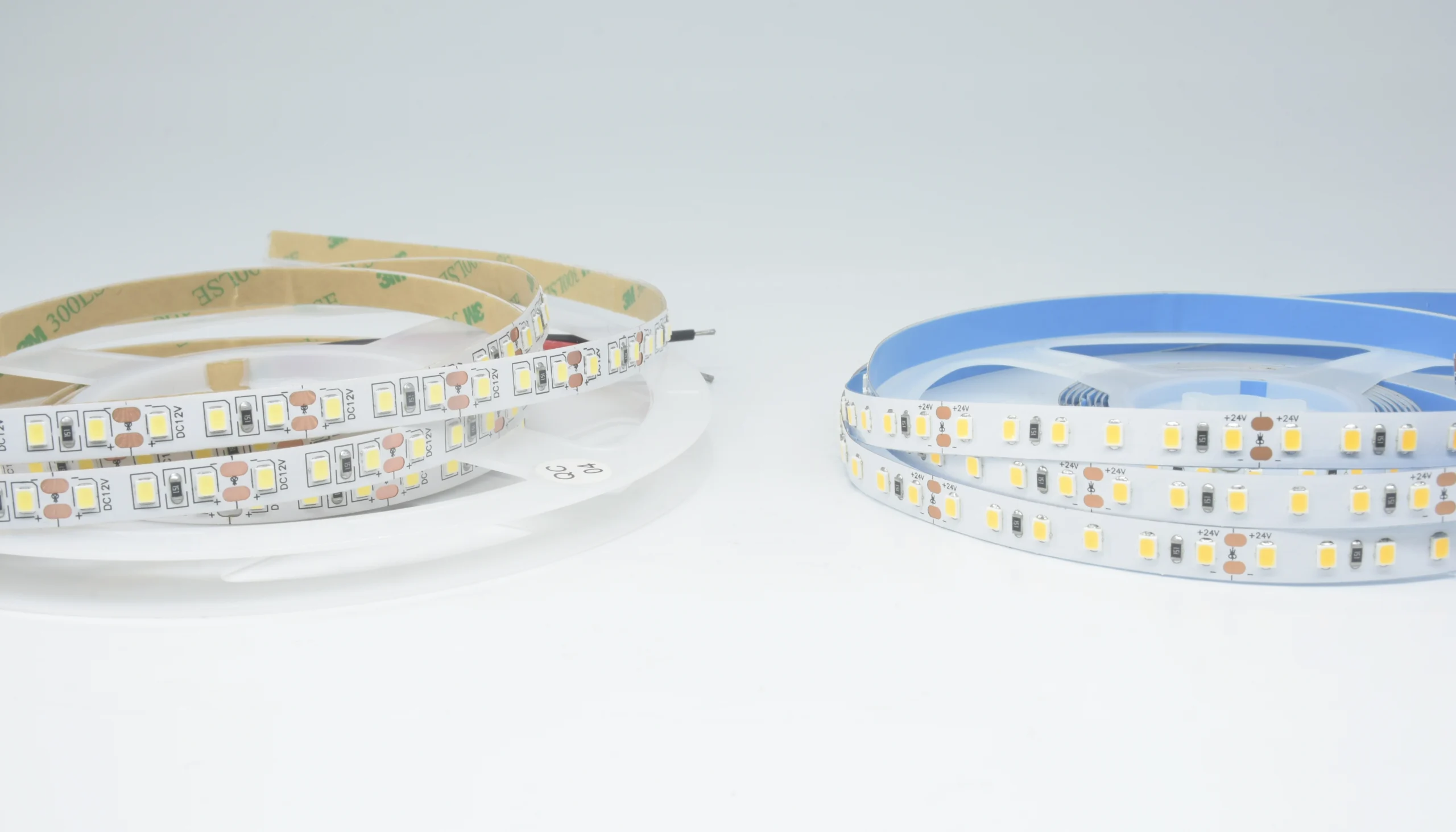
Best suited to short runs, existing 12V systems, vehicle or battery applications, and projects requiring shorter cut intervals.
Better suited to longer runs, higher-power loads, lower-current designs, and most commercial or architectural lighting projects.