CRI 80 vs 90 vs 95: How to Choose the Right CRI for LED Strip Lights
When choosing LED strip lights, voltage, wattage, lumen output and color temperature are usually the first specifications buyers compare. CRI, or Color Rendering Index, determines how naturally colors appear under the light.
CRI 80, 90 and 95 can all be suitable choices. The right level depends on the application, required color accuracy, efficiency and project budget.
1. What Is CRI?
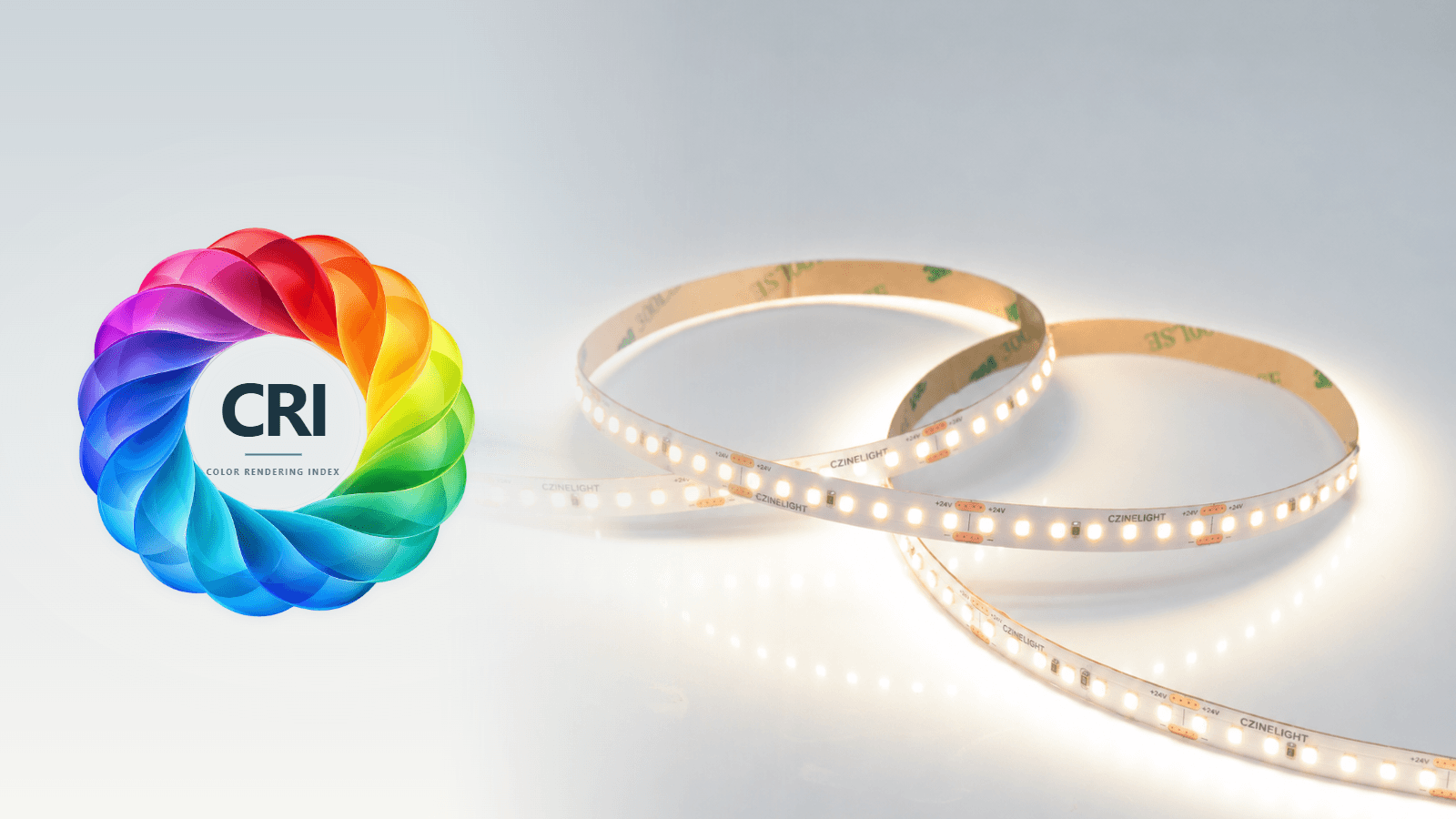
CRI stands for Color Rendering Index. It describes how accurately a light source reproduces object colors compared with a reference light source of a similar color temperature.
The commonly specified value is CRI Ra, calculated from test colors R1–R8.
A higher CRI generally means more faithful color reproduction.
For example, two LED strips can both be 3000K but make wood, fabrics, food or skin tones look noticeably different if their CRI values are different.
CRI and CCT Are Different
CCT describes the appearance of white light:
- 2700K–3000K: warm white
- 4000K: neutral white
- 5000K–6500K: cool white
CRI describes how colors appear under that light.
So CCT tells you what the white light looks like, while CRI tells you how objects look under it.
2. CRI 80 vs 90 vs 95 at a Glance
| CRI | Color Rendering | Efficiency | Cost | Typical Applications |
|---|---|---|---|---|
| CRI 80+ | Good | Generally higher | Lower | Cove lighting, indirect lighting, general illumination |
| CRI 90+ | Very good | Balanced | Moderate | Residential, retail, hospitality, cabinet lighting |
| CRI 95+ | Excellent | May be slightly lower | Higher | Galleries, premium retail, photography, color-critical lighting |
This comparison is a practical guide rather than a strict rule.
CRI is only one part of light quality. For demanding projects, R9, color consistency and spectral performance may also need to be considered.
3. What Is the Visible Difference Between CRI 80, 90 and 95?
The difference becomes more noticeable when the light illuminates colored materials rather than plain walls or ceilings.
CRI 80
CRI 80 usually provides acceptable color rendering for general lighting.
It is commonly suitable for:
- Cove lighting
- Corridors
- Indirect lighting
- Decorative lighting
- Warehouses
- General commercial lighting
For applications where maximum lumen output and cost efficiency are priorities, CRI 80 can be a practical choice.
CRI 90
CRI 90 usually produces more natural-looking colors, especially on:
- Wood
- Clothing
- Furniture
- Food
- Skin tones
- Interior finishes
For this reason, it is widely used in residential, retail, hospitality and commercial projects.
For many professional LED strip applications, CRI 90 offers a strong balance between color quality, efficiency and cost.
CRI 95
The difference between CRI 90 and 95 is usually subtler than the difference between CRI 80 and 90.
CRI 95 becomes more relevant when accurate color reproduction is an important part of the project, such as:
- Artwork
- Photography
- Premium retail
- Cosmetics
- Luxury interiors
- Textile displays
- Color inspection
This does not mean CRI 95 is necessary for every project. A hidden ceiling strip and a museum display do not have the same color-rendering requirements.
4. Why R9 Matters
CRI Ra does not include every test color.
The standard Ra value is based on R1–R8, while R9 represents saturated red and is reported separately.
This matters because two LED strips with similar CRI values can have very different red-rendering performance.
A low R9 can make:
- Skin appear pale
- Wood look less warm
- Red products appear dull
- Food look less natural
- Fabrics lose visual richness
R9 is therefore particularly useful for retail, hospitality, residential, food display and photography applications.
CRI 90 Does Not Automatically Mean High R9
A CRI 90 LED strip can still have different R9 performance depending on the LED package and phosphor formulation.
For projects where color quality matters, buyers should consider asking for:
- CRI Ra
- R9
- CCT
- SDCM
- Lumen output
- Spectral test data when required
This provides a more complete picture than looking at CRI alone.
5. Which CRI Is Best for Different Applications?
There is no single CRI specification that fits every project.
Cove and Indirect Lighting
Typical choice: CRI 80–90
When LED strips mainly illuminate ceilings or walls, CRI 80 may be sufficient. CRI 90 can be selected for more premium residential or architectural projects.
Residential Lighting
Typical choice: CRI 90+
CRI 90 is commonly used for kitchens, bedrooms, living rooms, wardrobes and cabinet lighting because these spaces contain furniture, fabrics, wood and skin tones.
Retail Lighting
Typical choice: CRI 90–95
CRI 90 works well for many retail environments. CRI 95 may be considered when merchandise color is especially important, such as fashion, cosmetics or premium displays.
Hotels and Restaurants
Typical choice: CRI 90+
Hospitality lighting often illuminates food, people, wood and textiles, making good color rendering particularly valuable.
Wardrobe and Cabinet Lighting
Typical choice: CRI 90+
Because users view clothing and materials at close distance, CRI 90 is often a practical specification.
Galleries and Museums
Typical choice: CRI 95+ or project-specific
Artwork and exhibition lighting may require more detailed spectral evaluation rather than relying only on CRI.
Photography and Video
Typical choice: CRI 95+ with strong R9
For photography and video, skin tones and saturated colors require more accurate spectral reproduction.
Commercial and Office Lighting
Typical choice: CRI 80–90
CRI 80 can meet many general lighting requirements, while CRI 90 may be preferred in premium interiors or customer-facing spaces.
6. Does Higher CRI Mean Lower Efficiency?
In comparable LED designs, higher CRI can result in slightly lower luminous efficacy.
High-CRI LEDs usually require a broader spectrum, including more red wavelengths. Some of this energy contributes less to measured lumens, so the resulting lm/W may decrease.
However, CRI alone does not determine LED strip efficiency.
Efficiency is also affected by:
- LED chip performance
- Phosphor formulation
- CCT
- Operating current
- PCB design
- Thermal management
- Voltage drop
- LED density
For this reason, buyers should compare the actual lm/W rather than assuming performance from CRI alone.
A well-designed CRI 90 strip can still achieve high efficacy.
7. How to Choose the Right CRI
A simple way to select CRI is to start with the application.
Choose CRI 80 When:
- Color accuracy is not critical
- The lighting is mainly indirect
- High luminous efficiency is important
- Budget is a major consideration
- The strip is used for general illumination
Choose CRI 90 When:
- The strip illuminates visible materials
- Natural color appearance matters
- The project involves residential or commercial interiors
- The application includes cabinets, retail or hospitality
- A balance between color quality and efficiency is required
For many residential and commercial LED strip projects, CRI 90 is a practical starting point.
Choose CRI 95 When:
- Color accuracy is an important project requirement
- Artwork or premium merchandise is illuminated
- Photography or video is involved
- Skin tones must appear more natural
- The project specification requires higher color fidelity
8. Look Beyond the CRI Number
CRI is useful, but it should not be the only specification used to judge light quality.
For professional projects, consider:
CRI Ra + R9 + CCT + SDCM + lm/W
For more demanding applications, spectral data or newer color-quality metrics such as TM-30 Rf and Rg can provide additional information.
This is particularly useful when comparing two LED strips that both claim CRI 90 or CRI 95 but perform differently in real installations.
Frequently Asked Questions
Is CRI 80 Good Enough for LED Strip Lights?
Yes. CRI 80 can be suitable for general, decorative and indirect lighting where precise color reproduction is not a priority.
Is CRI 90 Good for Residential Lighting?
In many residential applications, yes. It provides good color rendering while maintaining competitive efficiency and cost.
Is CRI 95 Worth It?
It depends on the application. For galleries, photography, premium retail and other color-sensitive environments, the additional color fidelity can be useful.
What Is a Good R9 Value?
There is no single R9 requirement for every application. Where red reproduction is important, a higher R9 value is generally preferred.
Does CCT Affect CRI?
They describe different properties, but LED spectrum and phosphor design can affect both. Always compare CRI within the actual CCT you plan to use.
Conclusion
The right CRI depends on what the LED strip is illuminating.
CRI 80 — suitable for general and indirect lighting.
CRI 90 — a balanced choice for residential, commercial, retail and hospitality projects.
CRI 95 — more suitable for premium and color-critical applications.
Instead of selecting LED strips by CRI alone, professional buyers should also consider R9, luminous efficacy, CCT and color consistency.
The goal is not to choose the highest CRI number, but to choose the right light quality for the application.