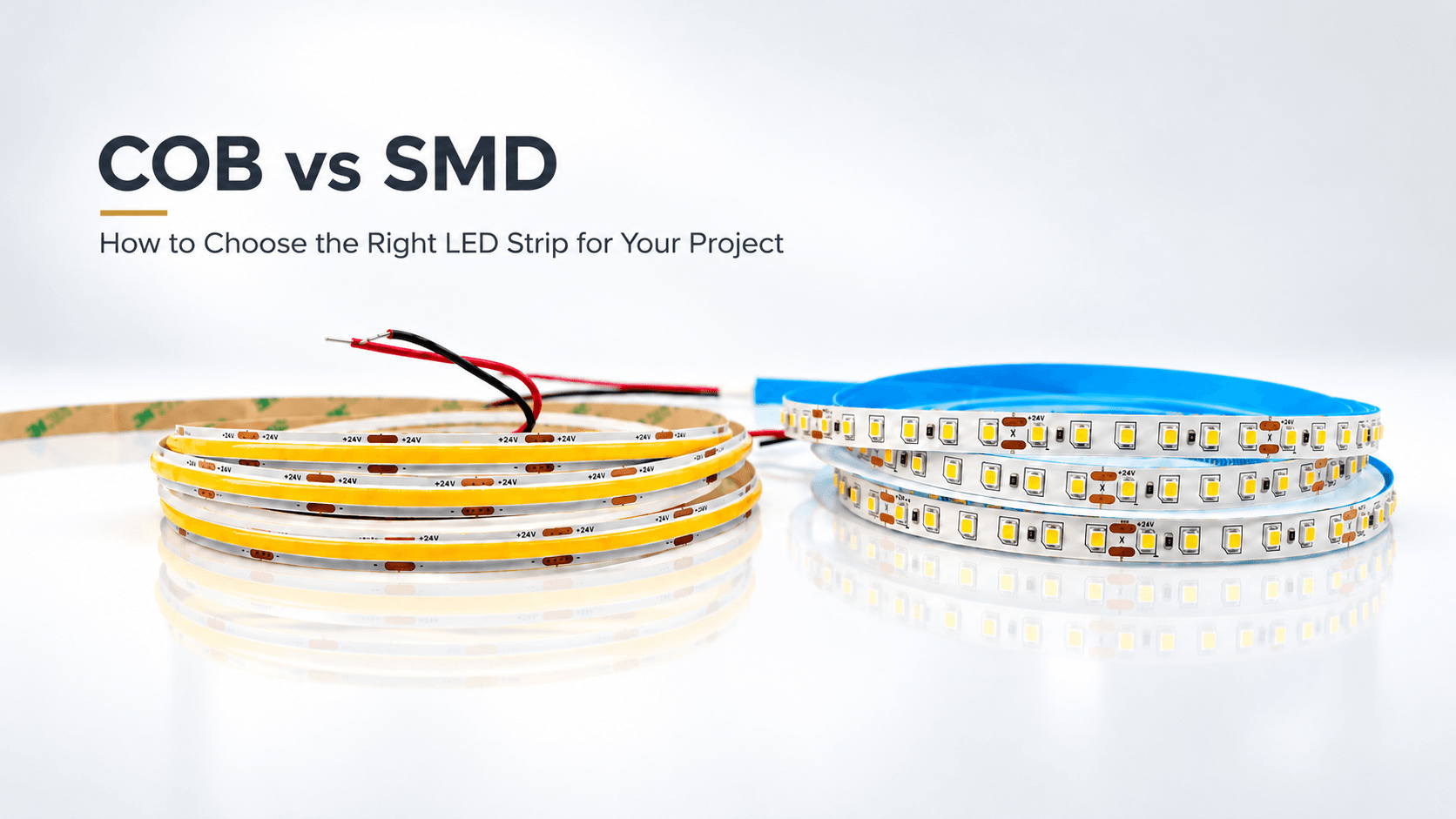
Choosing between COB and SMD LED strip lights is an important decision for lighting distributors, contractors, architects, and project buyers.
Both technologies are widely used in modern linear lighting. However, they differ in LED construction, visual uniformity, available specifications, and overall system cost.
The key question is not simply which LED strip is better, but which technology best meets the requirements of your lighting project.
1. What Is the Difference Between COB and SMD LED Strips?

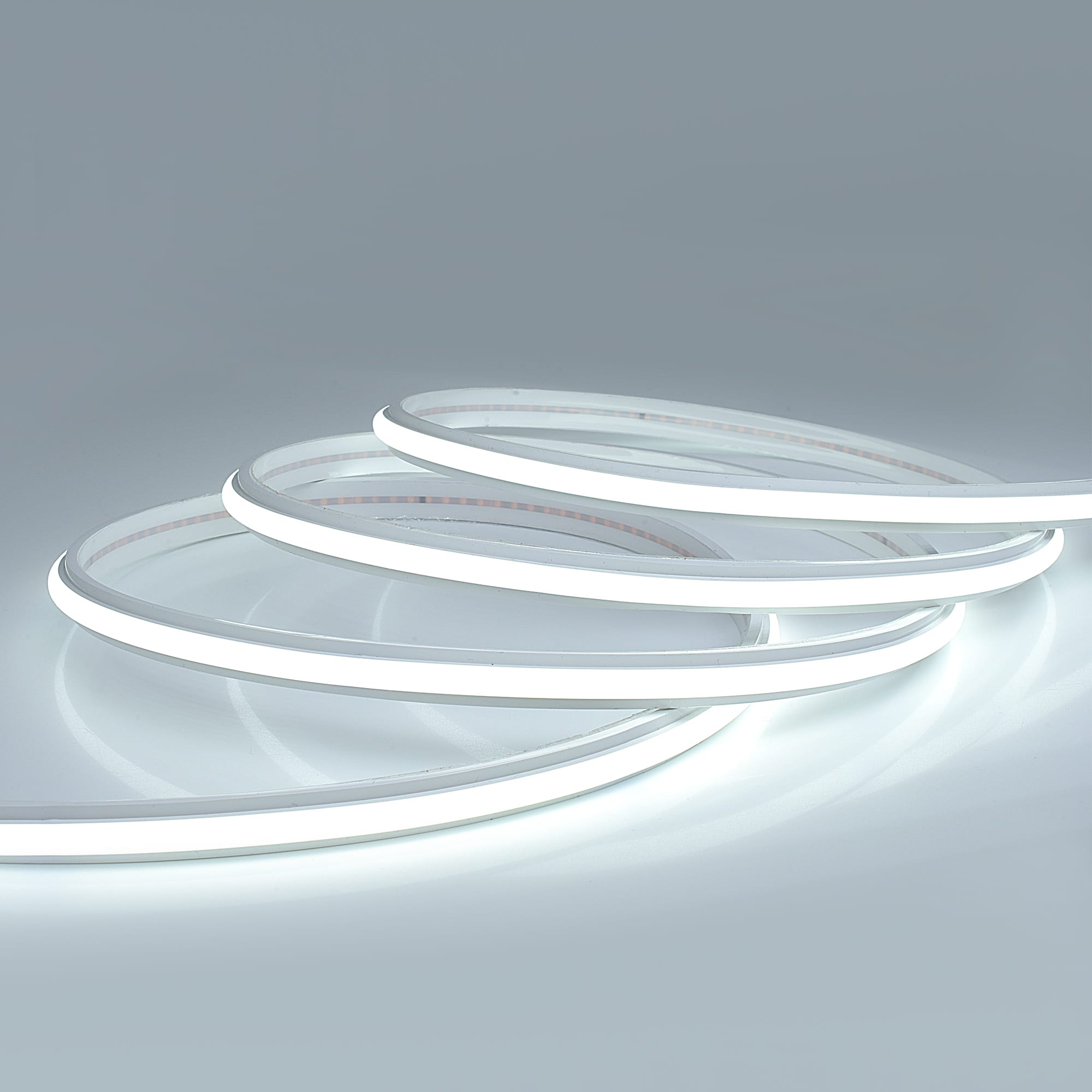
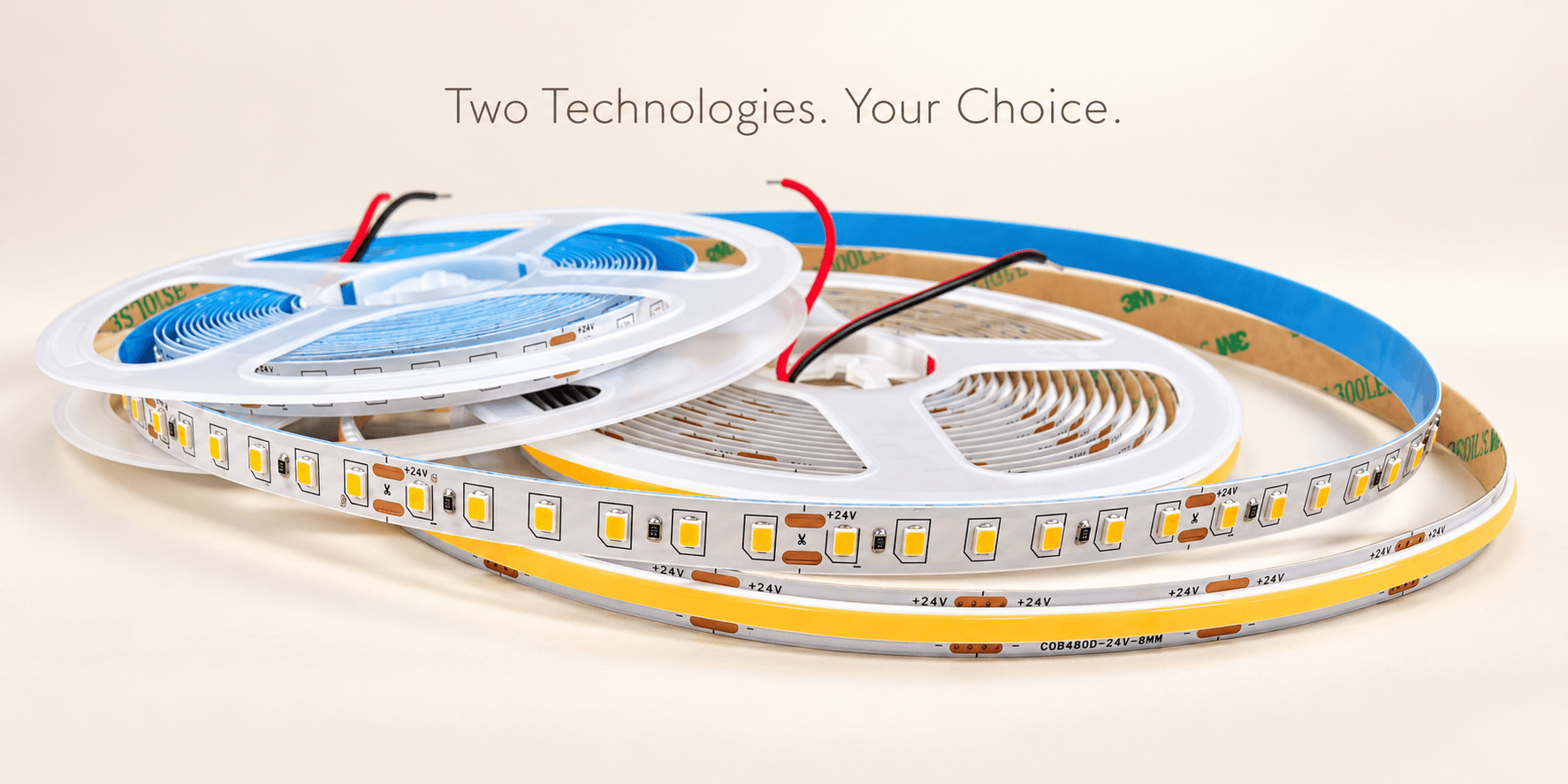
COB (Chip-on-Board) LED strips use numerous small LED dies mounted directly onto a flexible printed circuit board (FPCB). The light-emitting area is covered by a continuous encapsulation layer, typically containing phosphor for white-light conversion.
This construction creates a smooth, nearly continuous line of light with minimal visible LED dots.

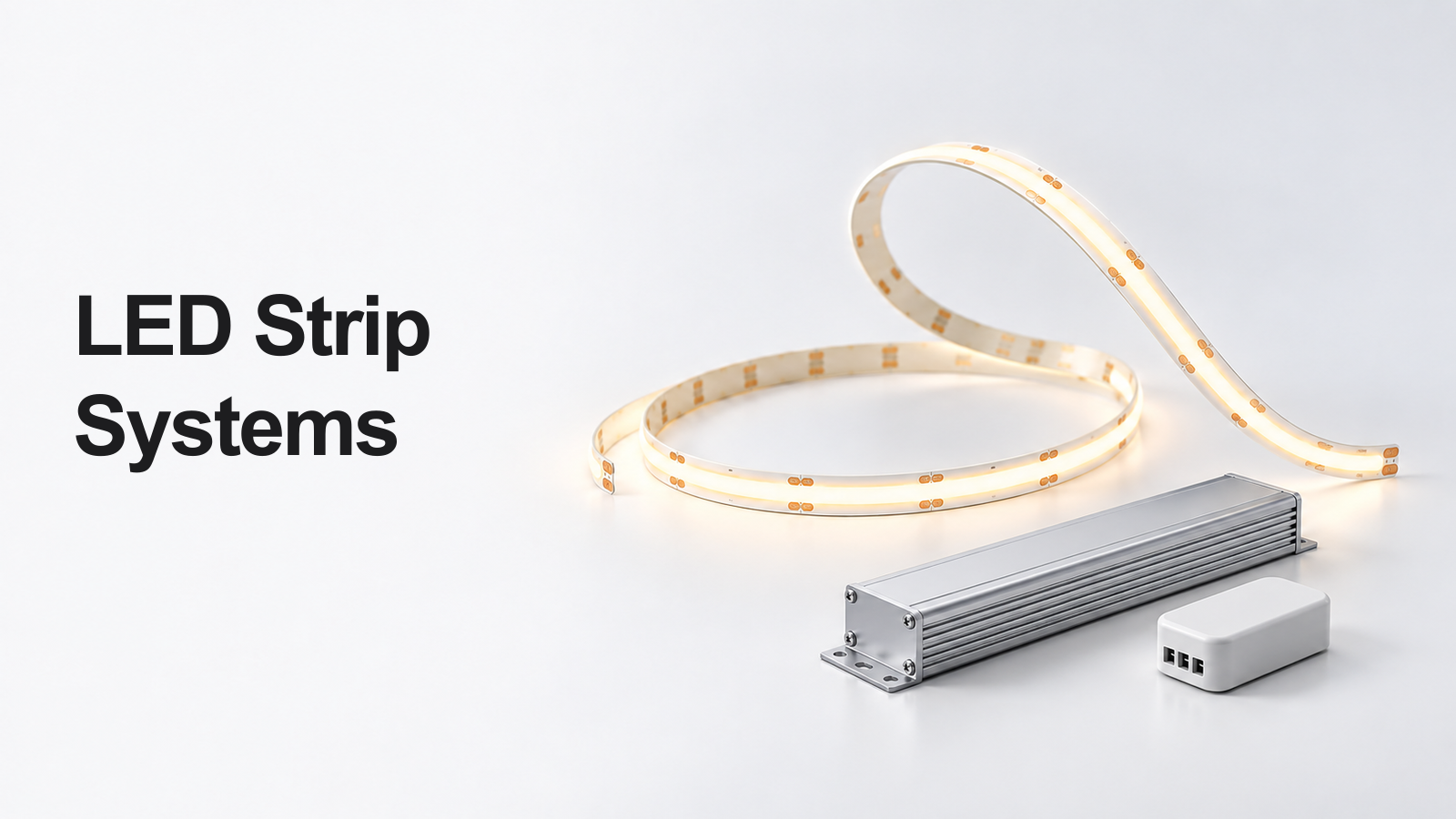
SMD (Surface-Mounted Device) LED strips use individually packaged LEDs, such as SMD 2835 or 5050, soldered onto a flexible circuit board at regular intervals.
Depending on LED density, installation depth, and diffuser design, individual light points may remain visible.
Both technologies can provide excellent lighting performance. Their main difference is the construction and distribution of the light sources.
2. COB vs SMD LED Strip: Technical Comparison
| Feature | COB LED Strip | SMD LED Strip |
|---|---|---|
| LED construction | Bare LED dies with continuous encapsulation | Individually packaged LEDs |
| Light appearance | Smooth, continuous-looking light | Individual light points may be visible |
| LED density | Typically very high | Varies widely by model |
| Brightness | Depends on specific design | Depends on specific design |
| Luminous efficacy | Model-dependent | Model-dependent |
| Color rendering | CRI 80, 90 or higher options | CRI 80, 90 or higher options |
| Installation | Well suited to shallow linear profiles | May require additional diffusion |
| Product cost | Often higher for comparable specifications | Broad range of price options |
| Typical applications | Visible linear lighting, cabinets, retail displays | Cove lighting, general lighting, decorative systems |
Important: Neither COB nor SMD technology automatically guarantees higher brightness, better efficiency, or longer service life. These characteristics must be evaluated using actual product specifications and operating conditions.
3. Why Choose COB LED Strips?
Smooth, Dotless Linear Lighting
One of the strongest advantages of COB LED technology is its visual uniformity.
Because many LED dies are positioned close together beneath a continuous light-conversion layer, COB strips can produce a more seamless lighting appearance.
This is particularly valuable in installations where the light source is directly visible or reflected by glossy surfaces.
According to LEDVANCE’s professional COB LED strip documentation, this technology is designed to provide homogeneous linear illumination without the distinct light points associated with conventional LED strips.
Suitable for Slim Lighting Profiles
In shallow aluminum channels, widely spaced SMD LEDs may produce noticeable bright spots.
COB strips can help reduce this effect, allowing designers to achieve a smooth lighting appearance with less optical mixing distance.
However, aluminum profiles and diffusers may still be required for heat dissipation, physical protection, and the intended lighting effect.
Applications Where COB Performs Well
COB LED strips are particularly suitable for:
Premium kitchen and wardrobe lighting
Hotel rooms and hospitality interiors
Retail shelves and display cabinets
Architectural linear lighting
Decorative wall and ceiling profiles
Furniture and exhibition lighting
For these applications, light uniformity and visual comfort often matter as much as luminous output.
4. When Is SMD LED Strip a Better Choice?
SMD LED strips remain a practical solution for many commercial lighting projects.
Concealed or Indirect Lighting
When the LED strip is hidden inside a sufficiently deep ceiling cove or aluminum channel, individual LED points may no longer be visible.
In these installations, a suitable SMD strip can achieve the required lighting effect without the additional cost of COB construction.
Wider Product and Control Options
SMD technology is available in a broad range of configurations, including different LED package types, power levels, colors, and control systems.
Specialized SMD products can be particularly useful for RGB, RGBW, and addressable lighting applications.
COB versions of these systems are also available, so the final selection should be based on the required control functionality and actual product availability.
Cost-Sensitive Lighting Projects
For large projects where the LED strip is concealed, SMD may offer a more economical solution.
However, purchasing decisions should consider the cost of the complete lighting system, including profiles, diffusers, drivers, installation, and maintenance.
A lower strip price does not always mean a lower total project cost.
5. Five Technical Factors Buyers Should Evaluate
For professional procurement, comparing COB and SMD technology alone is not enough.
The following performance factors should be verified before selecting an LED strip supplier.
5.1 Luminous Output and Efficiency
Brightness should be evaluated using luminous flux per meter (lm/m), while energy efficiency is expressed in lumens per watt (lm/W).
For example, a strip delivering 1,000 lm/m at 10 W/m has a nominal luminous efficacy of 100 lm/W.
A higher LED chip count does not necessarily mean greater brightness.
Buyers should compare products at similar color temperatures, CRI levels, and test conditions. They should also confirm whether the stated luminous output refers to the bare strip or the complete profile-and-diffuser assembly.
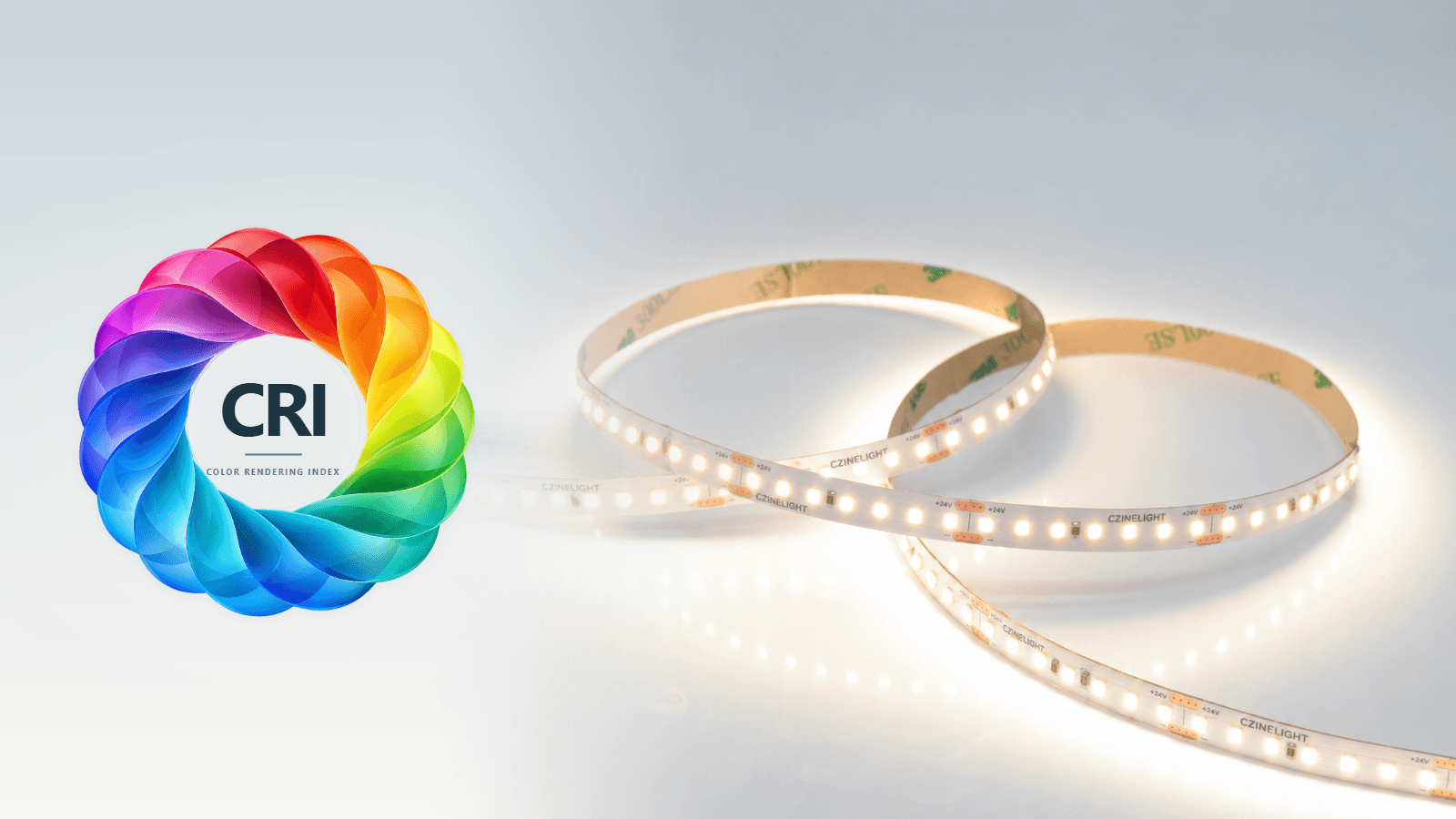
5.2 CRI and Color Consistency
Color quality is particularly important for retail stores, hotels, showrooms, and high-end residential lighting.
A CRI of 90 or higher is often a useful specification target where accurate color appearance matters.
For demanding projects, buyers may also request R9 values, color consistency expressed as SDCM, or an IES TM-30 report.
Both COB and SMD LED strips can achieve high color rendering. The result depends on the LED components and manufacturing design, not simply the strip type.
Related reading: CRI 80 vs 90 vs 95: How to Choose the Right CRI for LED Strip Lights.
5.3 Voltage and Maximum Run Length
Common low-voltage LED strip systems operate at 12V or 24V DC. Certain products also use 48V DC or other voltage configurations.
For longer runs, voltage drop may cause brightness variations toward the end of the strip.
The recommended maximum run length depends on power consumption, PCB conductor resistance, supply voltage, wiring, and the manufacturer’s design.
Neither COB nor SMD construction alone determines the maximum installation length.
For commercial projects, buyers should request maximum-run recommendations and consider power injection or multiple feed points when necessary.
5.4 Thermal Management
Both COB and SMD LED strips generate heat during operation.
The U.S. Department of Energy identifies thermal management as an important factor affecting LED performance, lumen maintenance, and reliability.
Suitable mounting surfaces, aluminum profiles, operating temperatures, and electrical loading should all be considered.
Neither technology should be assumed to have a longer lifespan without supporting reliability data.
5.5 Driver Compatibility and Installation Conditions
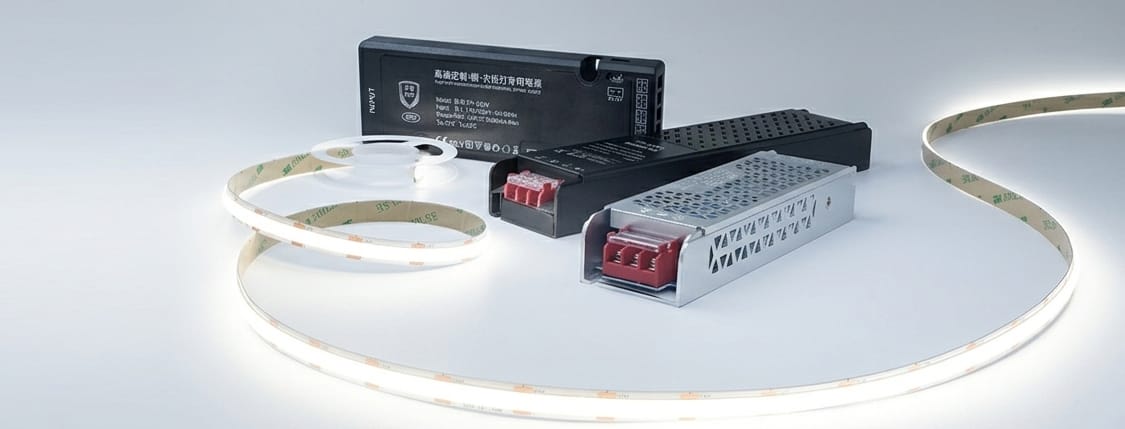
Most conventional 12V and 24V LED strips require a compatible constant-voltage power supply.
Driver selection should consider the total power requirement, environmental conditions, electrical specifications, and dimming compatibility.
For example, a 5-meter strip rated at 10 W/m requires 50 W at nominal full load. Allowing 20% power headroom gives a minimum target of 60 W, subject to the power supply manufacturer’s recommendations and operating-temperature derating.
The correct IP rating, cutting interval, bending radius, and mounting method must also be checked for the intended installation.
6. How to Choose Between COB and SMD for Different Projects

| Lighting project | Suggested starting point | Main consideration |
|---|---|---|
| Luxury wardrobe lighting | COB | Smooth visible light |
| Retail display shelves | COB | Uniform illumination and color quality |
| Hotel decorative lighting | COB | Continuous linear appearance |
| Hidden ceiling cove | COB or SMD | Brightness, cost, profile depth |
| Large concealed installations | SMD or high-efficiency COB | System efficiency and total cost |
| Dynamic RGB lighting | COB or SMD | Control requirements and color mixing |
| Budget-sensitive lighting | SMD | Overall installation cost |
7. What Should Distributors Ask an LED Strip Manufacturer?
For lighting distributors and OEM buyers, consistent product quality is essential.
Before confirming a bulk order, request product-specific documentation covering luminous flux, power consumption, CRI, color temperature, PCB construction, thermal performance, recommended run length, and applicable compliance requirements.
Sample evaluation should include full-length operation, brightness consistency, color uniformity, and performance in the intended aluminum profile.
It is also important to confirm whether the approved sample and mass-production batches use equivalent components and manufacturing specifications.
At CZINELIGHT, we recommend selecting LED strips based on measurable optical and electrical performance, rather than choosing solely by LED density or price per meter.
Frequently Asked Questions
Is COB LED strip better than SMD?
COB is generally preferred when smooth, continuous-looking light is the main requirement, especially in visible linear installations. SMD can be equally suitable for concealed lighting and projects requiring particular performance, control, or cost characteristics.
Are COB LED strips brighter than SMD strips?
Not necessarily. Brightness depends on luminous output, measured in lm/m, rather than LED packaging technology. A high-output SMD strip can be brighter than a lower-power COB strip.
Is COB LED strip more energy-efficient?
Not automatically. Both technologies offer different efficiency levels. Buyers should compare measured lm/W values under equivalent test conditions.
Do COB LED strips require aluminum profiles?
Aluminum profiles are often recommended for thermal management, mounting, and protection, particularly in higher-power installations. The exact requirement depends on the manufacturer’s thermal specifications.
Which LED strip is better for commercial projects?
Choose based on application requirements. COB is particularly effective for premium visible linear lighting, while SMD remains suitable for many concealed, high-output, specialized, or cost-sensitive applications.
Conclusion: Choose the Right LED Strip for the Application
COB and SMD LED strips are both established technologies with distinct advantages.
COB LED strips are an excellent choice when visual uniformity and a seamless lighting appearance are priorities. SMD LED strips remain highly competitive when flexibility in specifications, installation conditions, and cost is more important.
For professional buyers, the best decision comes from evaluating light quality, luminous efficacy, thermal performance, electrical design, and long-term product consistency.
Looking for a COB or SMD LED strip manufacturer?
CZINELIGHT provides LED strip manufacturing solutions for international distributors, lighting brands, and commercial lighting projects.
Contact CZINELIGHT to discuss your required voltage, strip width, LED density, color temperature, brightness, and OEM specifications.